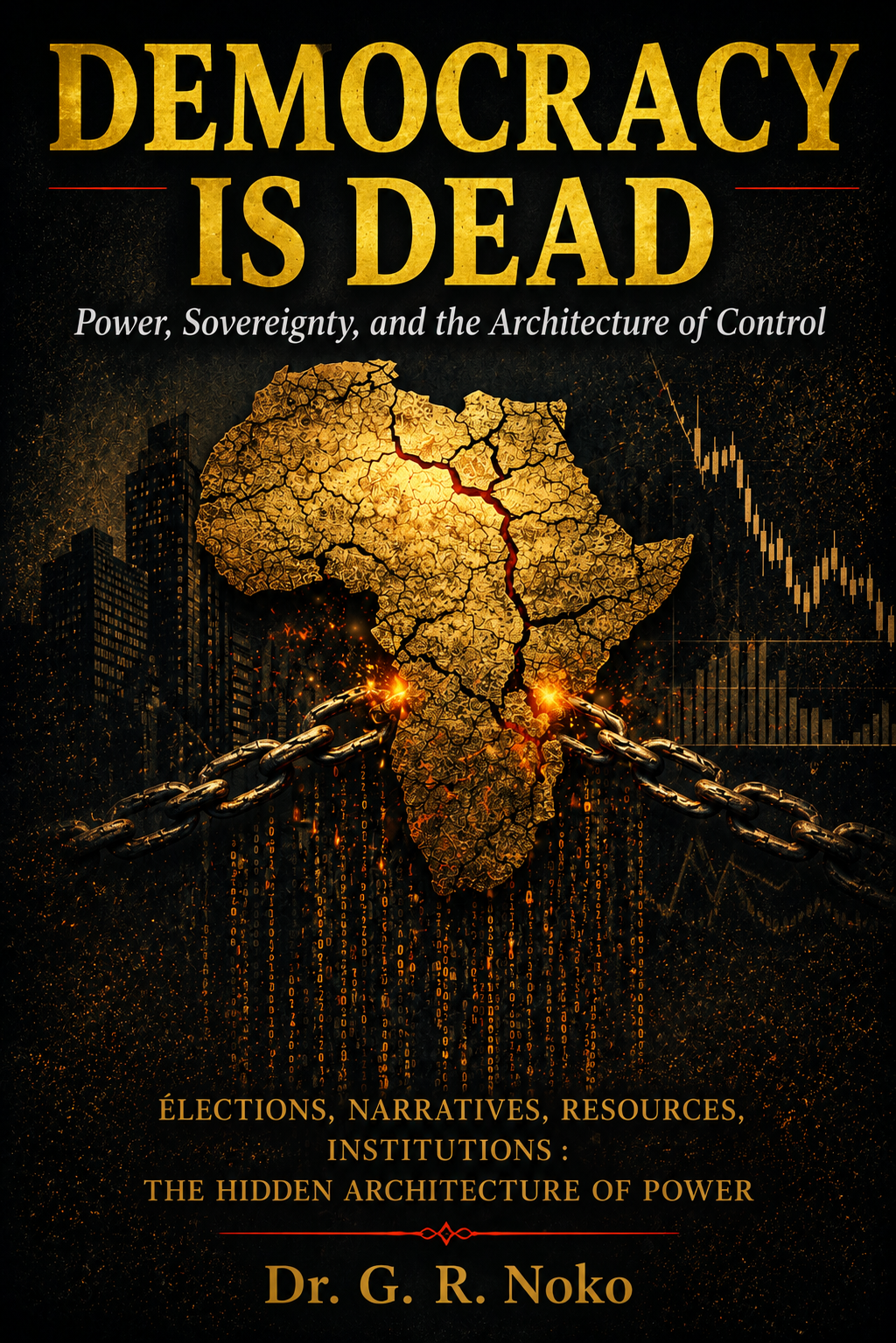
Democracy is Dead
by Dr. G. R. NOKO
"Beyond the ballot lies the architecture of power. Beyond rhetoric lies institutional design." The book argues that the real challenge of the twenty-first century is not merely changing leaders, but redesigning systems that place sovereignty, accountability, and development at the service of the people.
Choose Format
Hard Copy
Printed book, shipped to you
R350.00
Out of stock
About This Book
Democracy Is Dead
Power, Sovereignty, and the Architecture of Control
By Dr. G. R. NOKO
Summary
Democracy Is Dead challenges one of the most accepted assumptions of modern politics: that elections automatically place power in the hands of the people. The book argues that while democracy remains a valuable political system, voting alone does not guarantee genuine sovereignty, justice, prosperity, or public control over governance.
The central thesis is that real power often lies beyond the ballot box. It resides in the structures that influence political outcomes long before citizens cast their votes—campaign financing, media ownership, corporate influence, resource control, international financial systems, and institutional design.
The book begins by examining the origins and promises of democracy, including freedom, accountability, human rights, and citizen participation. It then asks a difficult question: if democracy works as intended, why do many democratic nations continue to struggle with poverty, inequality, corruption, and elite domination?
As the discussion progresses, the book explores how political elites, wealthy donors, lobby groups, and media organizations shape public opinion and political choices. It argues that in many cases, citizens choose from options that have already been influenced by powerful interests.
A significant portion of the book focuses on Africa's post-independence experience. It examines colonialism, neo-colonialism, the CFA Franc system, resource control, and the continuing struggle for economic sovereignty. The book contends that political independence is incomplete without economic independence and strategic autonomy.
Through case studies of Botswana, Norway, Angola, Burkina Faso, Mali, Niger, Rwanda, and Cameroon, the author evaluates different governance models. Botswana is presented as an example of successful resource management through strong institutions, while the Sahel states are examined as examples of sovereignty-driven political transformation. Rwanda is analyzed through the lens of stability and development, while Cameroon is explored as a model of gradual sovereignty through diplomacy, institutional continuity, and strategic autonomy.
The book also revisits the intellectual foundations of Pan-Africanism through the ideas of Kwame Nkrumah, Thomas Sankara, Steve Biko, and Ruben Um Nyobè. It then examines a new generation of Pan-African voices—including Ibrahim Traoré, Julius Malema, Kemi Seba, Nathalie Yamb, Franklin Nyamsi, and Bobi Wine—who use digital platforms to promote debates on sovereignty, economic justice, and African self-determination.
A major theme throughout the book is the battle between stability and freedom. It asks whether political stability can accelerate development and whether excessive political competition can sometimes undermine long-term national planning. The author argues that neither stability nor freedom alone is sufficient; effective governance requires a balance between the two.
The final chapters look toward the future of governance. Rather than advocating the abandonment of democracy, the book calls for its evolution. It proposes governance systems that combine democratic participation, economic sovereignty, transparency, resource accountability, technological innovation, and long-term national planning.
Ultimately, Democracy Is Dead concludes that democracy is not truly dead. What is dying is the assumption that elections alone are enough. The future belongs to societies that understand the deeper architecture of power and build institutions capable of transforming sovereignty into tangible improvements in the lives of their citizens.
You May Also Like
The 10 Years Old AI Genius
Dr. G. R. NOKO
From using Ai to deploying Ai to building AI

Je suis Camerounais
Dr. G. R. NOKO
« Je suis Camerounais est un appel audacieux et émouvant à l’unité nationale au-delà des tribus, des langues et des divisions. Il enseigne que l’identité doit précéder les différences et que chaque citoyen partage un lien plus profond qu’aucune force politique, culturelle ou historique ne devrait briser. »

The Scapegoat Foreigner
Dr. G. R. NOKO
Misplaced blame does not fix unemployment, improve infrastructure, strengthen education systems, or create sustainable economic growth. It only redistributes frustration.